ıCare Family Dental
Dental Fillings in Chatswood
When a tooth needs repair, a tooth-coloured filling may be a conservative way to restore its shape and function if it has a cavity, chip, worn area or other local damage. The right treatment depends on how much tooth structure remains, how the tooth meets the opposing teeth, and whether the problem is limited to the outer tooth or extends deeper.
At iCare Family Dental, our approach is to preserve as much natural tooth structure as clinically appropriate. That starts with an assessment: for some teeth, a direct composite restoration may be enough; for others, an onlay, crown, root canal treatment or another option may be more suitable.
A tooth does not have to hurt to need attention. Early decay and problems around an existing filling can sometimes be found before they cause obvious pain.
Consultations are available in English, Mandarin and Cantonese at our Chatswood clinic.
Why might a filling be recommended?
A dental filling replaces a local area of tooth structure that has been lost or needs repair. An assessment may be worthwhile if you notice:
- a visible hole or an area that looks different from the surrounding tooth;
- a chipped, broken, worn, rough or sharp edge;
- sensitivity to cold, heat, sweet foods or biting;
- an existing filling that feels loose, rough or damaged; or
- no symptoms, but a dentist has found a concern during an examination or on a clinically necessary X-ray.
No single symptom confirms that you need a filling, and no pain does not rule one out. Some early changes in enamel that have not formed a cavity may be managed with preventive care and monitoring. Once there is a cavity or structural loss, a restoration may be needed. The purpose of the examination is to distinguish between those situations rather than assume every mark needs drilling.
Tooth-coloured repair, shaped for your tooth
Composite resin is a white or tooth-coloured material that bonds to the prepared tooth. It can be used for fillings in front or back teeth and for some localised chips or broken areas when the clinical conditions are suitable.
“Tooth-coloured” describes the appearance of a restoration, not one material or treatment. Composite is placed directly on the tooth. When more coverage is needed, a tooth-coloured onlay or crown may be considered as a different kind of restoration.
The dentist places and shapes composite directly on the tooth. The aim is to restore the missing form, create a comfortable bite and choose a shade that works with the surrounding teeth. Natural teeth vary in colour, texture and translucency, so a close match is an objective rather than a promise that every restoration will be invisible.
The most suitable material is not decided by colour alone. Tooth position, the size of the repair, bite forces, the ability to keep the area dry, remaining tooth structure and the role the tooth needs to perform all matter. The most suitable recommendation may therefore differ from one tooth to another.
What happens at the appointment?
-
01
Assessment and options
The dentist examines the tooth, surrounding teeth, bite and any existing restoration. An X-ray may be recommended when it is clinically useful to assess an area that cannot be seen directly. You can discuss what has been found, whether a filling is enough and what alternatives should be considered.
-
02
Local anaesthetic when appropriate
Before treatment, the dentist will explain whether local anaesthetic is appropriate. If it is used, it numbs the tooth and nearby area while you remain awake. A very small repair may not always require numbing; the decision depends on the tooth, the depth and location of the work, and your comfort.
-
03
Preparing and restoring the tooth
The treatment area is kept clean and dry. Decayed or unsupported tooth structure is removed as clinically required, while sound tooth structure is preserved where possible. For a composite restoration, the tooth is prepared for bonding and the material is placed and shaped to rebuild the missing area.
-
04
Finishing and bite check
The restoration is finished and polished. You will be asked to bring your teeth together so the dentist can check how the new surface meets your bite and make any necessary adjustment.
The number and length of appointments depend on what the assessment finds, the tooth involved and the treatment selected.
Front-tooth composite restoration: one patient case
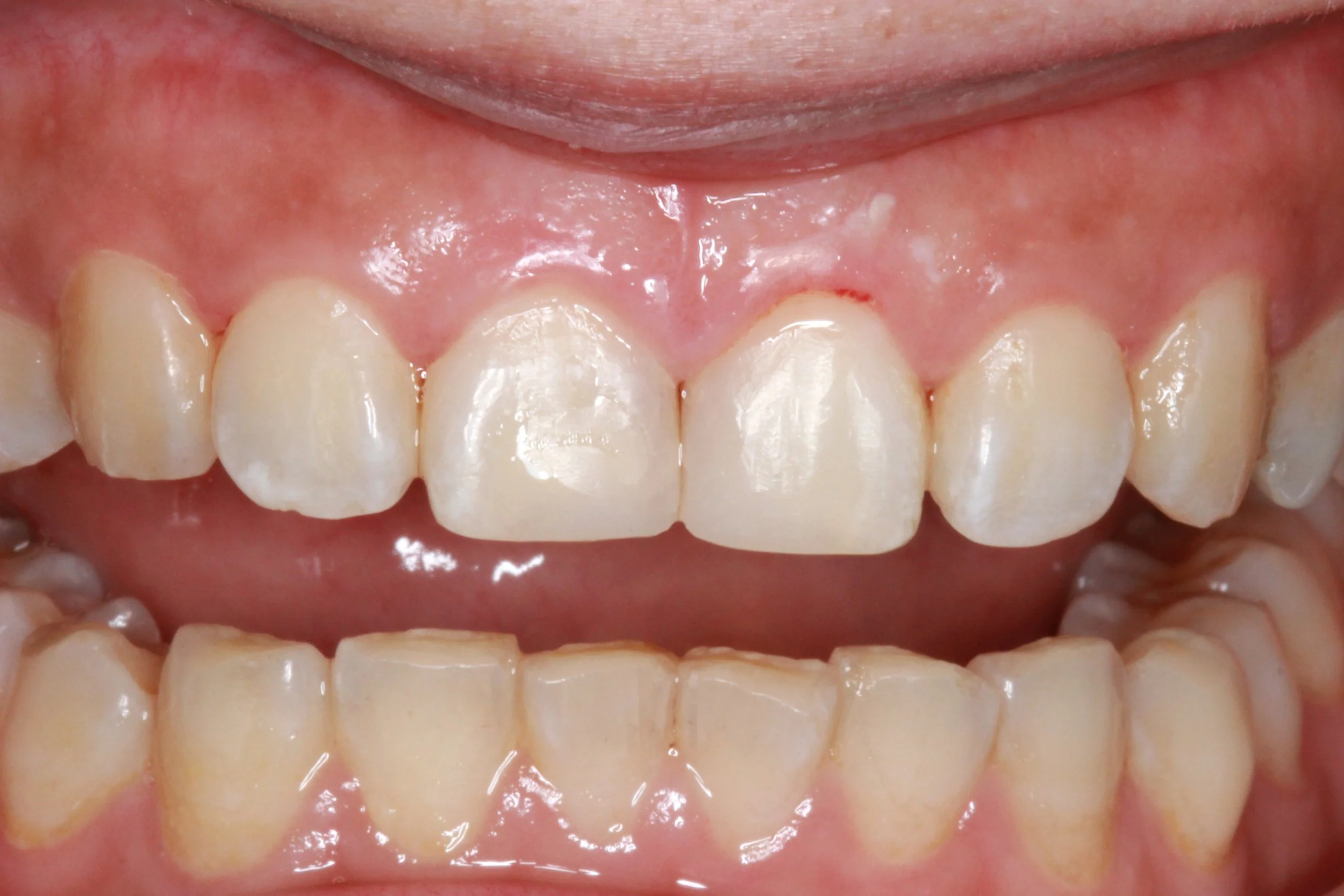
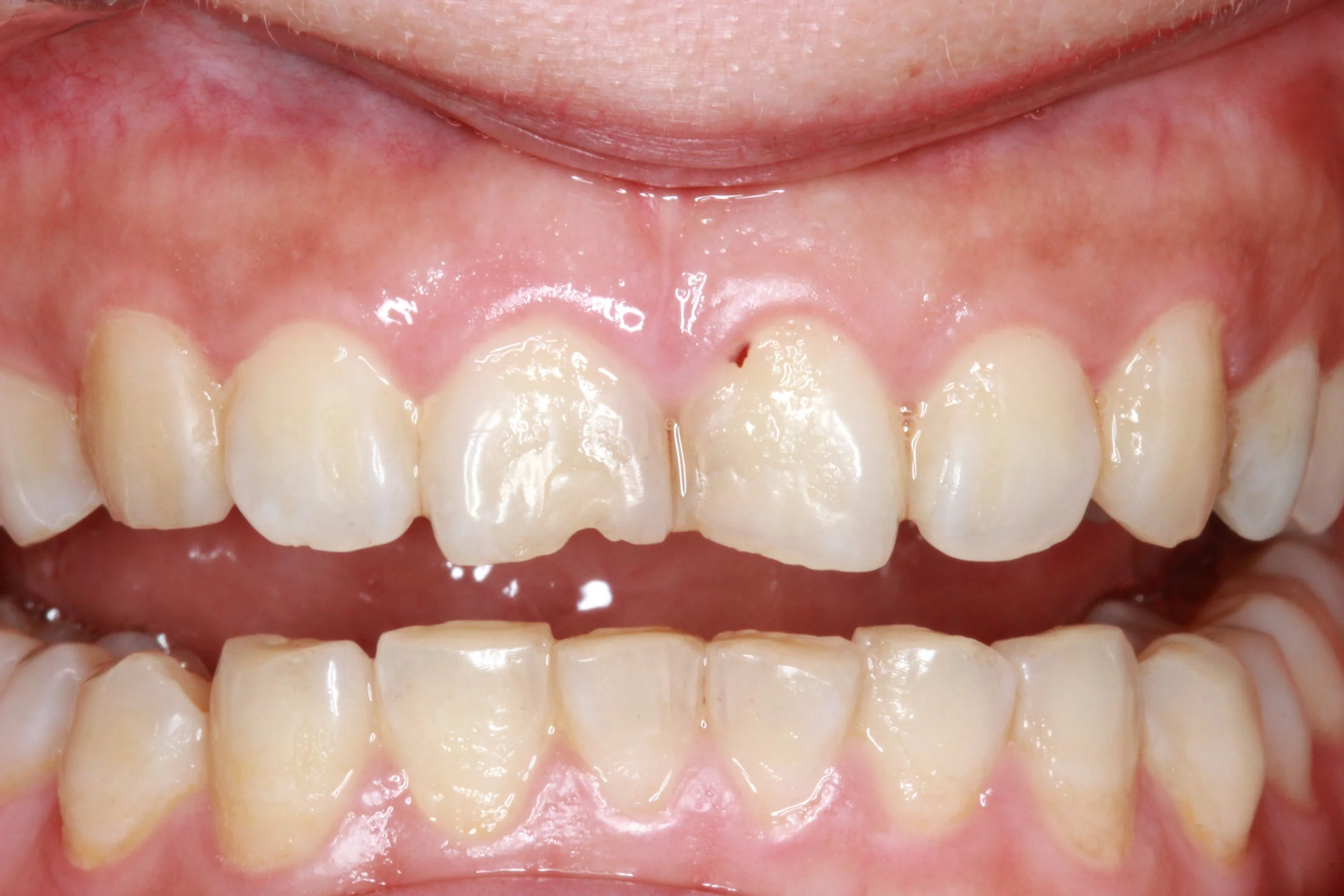
This anonymous case shows small irregularities along the edges of two upper front teeth before treatment. Composite was used to rebuild the treated edges, creating a more continuous outline in the after photograph. This front-tooth composite restoration was completed by iCare.
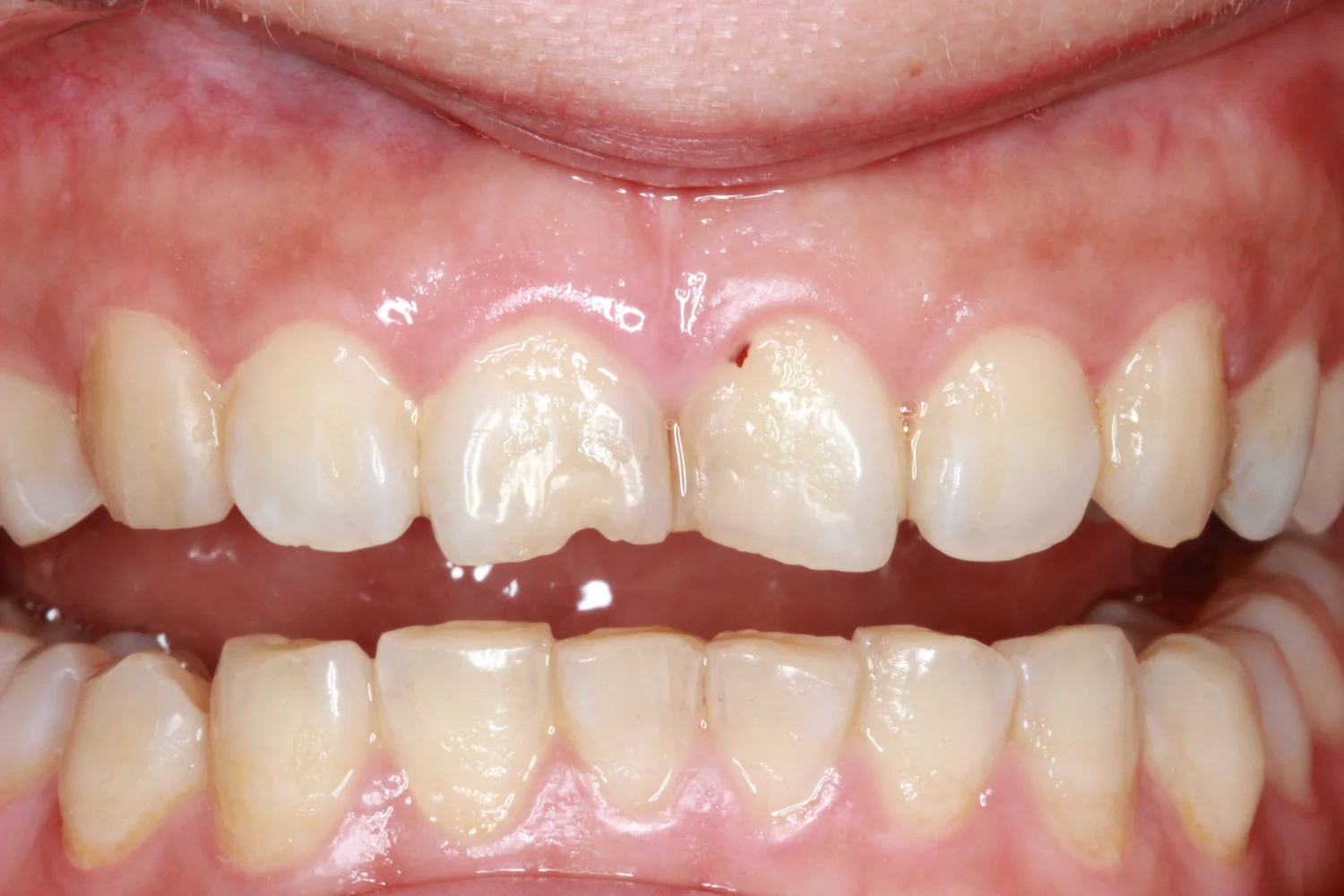
Before: small irregularities are visible along the upper front-tooth edges.
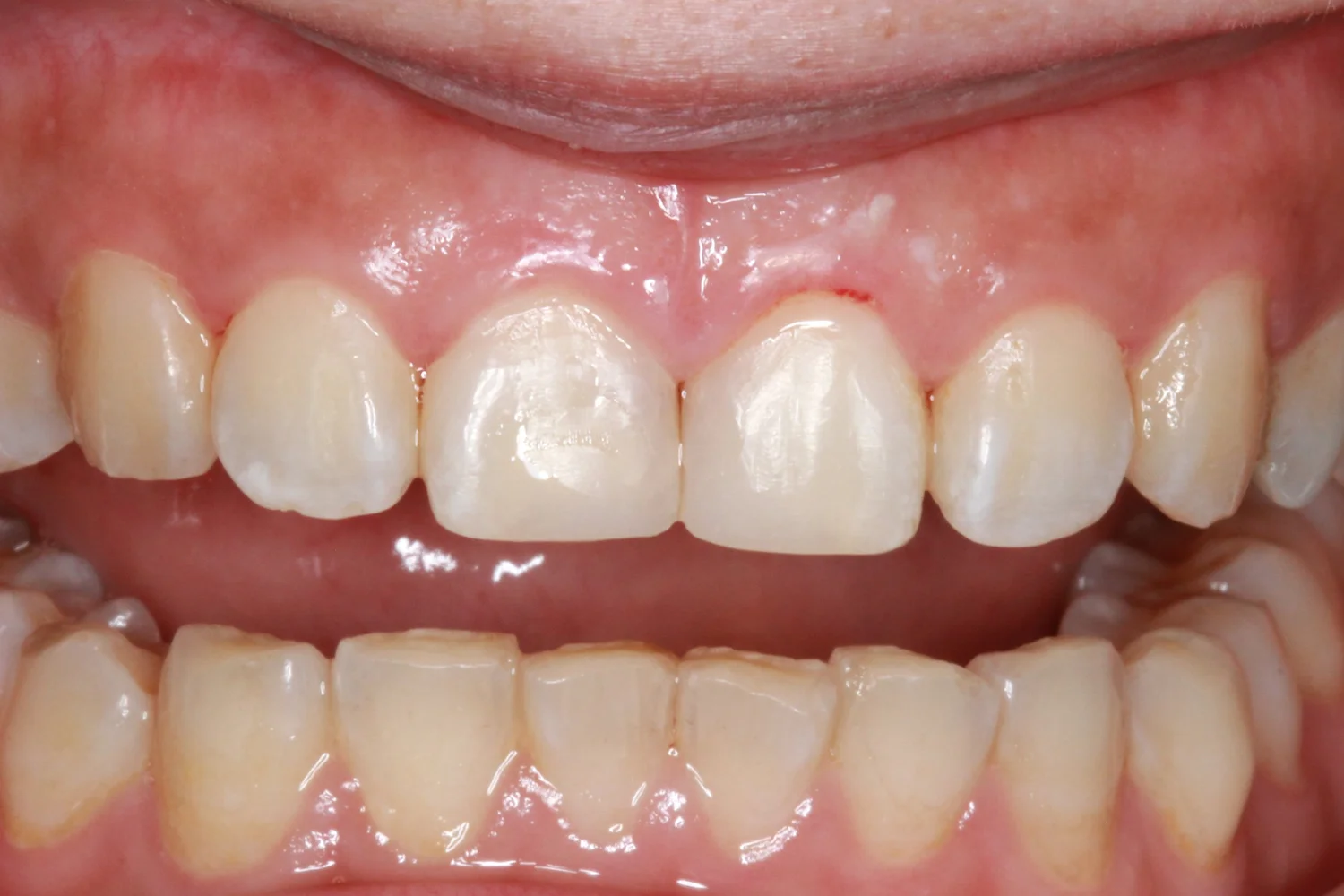
After: the upper front-tooth edges following composite restoration.
The photos document this single case. The treatment suitable for another person depends on an individual assessment.
Filling, onlay or crown: what is the difference?
These restorations differ mainly in how they are made and how much of the tooth they cover.
| Option | General role | Coverage |
|---|---|---|
| Direct filling | Repairs a local cavity, chip or damaged area by placing and shaping material directly on the tooth | Limited to the prepared area |
| Onlay | An indirect restoration made to replace lost tooth structure and cover one or more weakened biting surfaces | More coverage than a local filling, but less than a crown |
| Crown | A cap made to fit over a tooth that needs broader rebuilding or protection | Covers the visible tooth more extensively |
The choice is not based on size alone. The dentist also needs to consider remaining support, cracks, bite and pulp health. If the problem reaches or affects the dental pulp, a filling by itself may not address it; see root canal treatment for that separate treatment pathway.
For a broader change to the colour, shape or proportions of front teeth, dental veneers are a different conversation. A black triangle near the gumline also has a separate assessment and, in suitable cases, may be treated with the Bioclear Black Triangle Matrix System rather than as an ordinary filling.
Does an older filling need to be replaced?
Not automatically. A filling can wear, chip, crack, stain or lose its seal over time, but age or colour change alone does not prove that complete replacement is necessary.
After examining the tooth and restoration, the options may include:
- monitoring a filling that remains sound;
- smoothing or refurbishing a rough surface;
- resealing or repairing a local defect while retaining the sound portion; or
- replacing the restoration when the damage, decay or loss of seal is too extensive for a local repair.
Removing a filling can also remove additional tooth structure, so the decision should be based on the condition of the restoration and tooth beneath it — not on a fixed replacement date. If a filling feels loose, breaks, changes your bite or is associated with new sensitivity or pain, arrange an assessment.
Sensitivity and care after a filling
A restored tooth may be temporarily sensitive to cold, heat, sweet foods or biting. This often improves over the following days, although some teeth take longer. Contact your dentist if the sensitivity is not improving, becomes stronger, or the bite feels noticeably uneven.
If local anaesthetic was used, take care not to bite your lip or cheek while the area is numb and follow the instructions given for your particular tooth.
To look after both the restoration and the natural tooth around it:
- brush twice daily with fluoride toothpaste;
- clean between the teeth each day;
- keep sugary foods and drinks to mealtimes where practical;
- avoid using teeth to open packaging or bite hard non-food objects; and
- attend dental examinations at the interval recommended for your individual needs.
Fillings do not have a guaranteed or fixed lifespan. Their condition should be checked along with the rest of the tooth so that any change can be assessed on its own merits.
What affects the cost of a dental filling?
The fee can vary with the tooth involved, the size and location of the repair, the number of surfaces or teeth being treated, the material selected, the condition of an old restoration, treatment complexity and whether further diagnostic or restorative care is needed.
Before proceeding, ask for the recommended treatment, alternatives, relevant item numbers and expected out-of-pocket cost once the tooth has been assessed.
When a damaged tooth needs urgent care
A small, stable chip still deserves a dental assessment, but it is not the same as a serious dental injury. Arrange prompt care if a tooth is cracked, chipped or loose after an accident, or if you have significant pain, swelling, fever or a broken/lost filling that leaves the tooth uncomfortable.
Use our Emergency Dentist page for the urgent-care pathway. Call triple zero or go straight to an emergency department if you have trouble breathing, talking or swallowing; heavy bleeding into the throat; or marked mouth or tongue swelling. If a permanent (adult) tooth has been knocked out, seek urgent dental care immediately — ideally within 30 minutes — or go to the nearest emergency department if urgent dental care is unavailable. A knocked-out tooth is not, by itself, a reason to call triple zero unless one of those medical emergencies is also present.
Book an assessment in Chatswood
You do not need to decide for yourself whether the tooth needs a filling, an onlay, a crown or something else. The next step is an assessment and a clear explanation of the options.
iCare Family Dental is at Shop 3, 379 Victoria Avenue, Chatswood NSW 2067, with the entrance on the Archer Street side. There is two hours free parking at Chatswood Chase, and the clinic is about a seven-minute walk from Chatswood Station. Consultations are available in English, Mandarin and Cantonese.
Choose the general Consultation appointment type. The booking form does not have a field for the treatment reason, so tell reception and your dentist what you would like assessed when you arrive. For help with an urgent concern, call (02) 8068 6828.