Children’s Dental Care in Chatswood
Care as they grow, your child’s visit should begin with what they need now: a first look for a baby, a routine check-up for an older child, or an assessment of pain, injury or another concern.
At iCare Family Dental, children’s appointments are provided in a general dental practice. The dentist can assess the reason for the visit and explain appropriate next steps.
A practical first step
When should my child first see a dentist?
A child’s first dental visit is recommended when their first tooth appears, or by their first birthday—whichever comes first.
An early visit
Assessment and prevention first
An early visit usually focuses on assessment and prevention rather than assuming treatment is needed. It gives the dentist a chance to check the teeth and mouth, answer questions about brushing, food, drinks, dummies or thumb sucking, and help the setting become familiar before a painful problem develops.
Starting later
It is still a useful time to begin
If your child is already older and has not seen a dentist, you have not missed the chance to start. Arrange a visit now rather than waiting for pain.
Book sooner
When you notice a change
Book sooner if you notice a dark or chalky spot, a broken tooth, swelling, ongoing discomfort, an injury, difficulty eating, or a change in how the teeth meet.
The first appointment
What happens at a child’s first dental visit?
The appointment usually begins with a conversation. The dentist may ask about your child’s health, medicines, allergies and development; any pain, injury or change you have noticed; previous dental experiences and anything that worries your child; brushing, toothpaste, food and drinks; and dummies, thumb or finger sucking, mouth breathing or other habits you want to discuss.
- Look at what your child can manage The dentist will then look at as much as your child can comfortably and safely manage. This may include the teeth, gums and other parts of the mouth, along with how teeth are appearing and how the upper and lower teeth meet.
- Match the visit to their age For a baby or toddler, the examination may be very brief, with a parent close by. For an older child, there may be time for a more complete examination and practical brushing advice.
- Discuss only what may be useful Depending on age, symptoms, findings and cooperation, the dentist may discuss a professional clean, fluoride or an X-ray and explain why it may be useful.
- Leave with a clear explanation The useful outcome is a clear explanation: what looks healthy, what needs watching, what can be improved at home, and whether another appointment or treatment discussion is needed.
Fees and government benefits
Children’s dental fees and the Child Dental Benefits Schedule
CDBS is available to eligible children aged 0–17 who are eligible for Medicare and meet the relevant Australian Government payment criteria. Eligibility can depend on the child’s or family’s circumstances, and Services Australia determines eligibility.
At iCare, an eligible service can be bulk billed with no gap when the child is eligible, the specific service is claimable under CDBS, sufficient available benefit balance remains, and the relevant CDBS item rules are met.
View CDBS details
What the benefit may include
For a CDBS benefit period that starts in 2026, the benefit is up to $1,158 over two calendar years. Eligible services can include examinations, X-rays, cleaning, fissure sealing, fillings, root canal treatment and extractions, subject to CDBS item rules. Orthodontic, cosmetic and hospital dental services are not covered.
Check your child’s eligibility and available balance in myGov: select Medicare, then History and statements, then Child Dental Benefits Schedule.
Ask the practice to confirm whether a proposed service is covered and whether any cost applies before treatment.
A calm, honest approach
What if my child feels nervous or cannot manage every step?
Crying, closing the mouth, needing a break or deciding that enough is enough can all happen at a dental visit. It does not make a child “difficult”, and it does not mean the appointment has failed.
Tell the team if your child is anxious, has sensory or communication needs, has had a difficult experience before, or has particular triggers. The dentist can decide what can be completed safely that day. If an important part of the examination or care cannot be completed, the next step may be another visit or a staged approach.
Some children with complex medical, developmental or behavioural needs may require an appropriate specialist or hospital pathway.
Care matched to the child
What may a children’s dental check-up include?
A check-up builds a picture of the child’s current oral health. Depending on the child and the reason for attending, the dentist may consider the areas below.
A broader look at oral health and development
- Signs of tooth decay, including areas that need monitoring.
- The gums and other parts of the mouth.
- How well plaque is being removed at home.
- Tooth eruption, spacing or crowding.
- How the upper and lower teeth meet.
- Diet, drinks and the frequency of sugary snacks.
- Brushing, flossing and age-appropriate fluoride toothpaste.
- Habits such as thumb sucking or dummy use.
- Previous injuries, pain or sensitivity.
- The child’s current risk of decay and a suitable time for review.
Selective prevention
Are X-rays, fluoride and fissure sealants always needed?
No. Each is a separate decision based on what the dentist finds and what information or protection is likely to be useful.
When more information is needed
Dental X-rays
The dentist may consider a dental X-ray when important information cannot be obtained by looking in the mouth alone—for example, to investigate decay between teeth, infection, an injured tooth, a missing or delayed tooth, or development below the gums.
How the decision is made
The reason for an X-ray will be explained before it is taken. The type of X-ray and the area examined will be selected according to what needs to be checked, with particular care to minimise radiation exposure in children while obtaining the information needed for diagnosis.
When decay risk is higher
Fluoride treatment
Fluoride varnish may be discussed when an assessment shows an increased risk of tooth decay. That decision can be influenced by current or previous decay, the condition of the teeth, home care, diet and other risk factors. The dentist can explain the expected benefit for your child.
How it differs from toothpaste
Fluoride varnish at the dental practice is different from the everyday use of age-appropriate fluoride toothpaste. The dentist can explain what is suitable for your child.
Protecting deep grooves
Fissure sealants
Fissure sealants are thin protective coatings placed over the grooves of back teeth. They are most often considered after permanent molars appear, particularly when the grooves are deep and difficult to keep clean.
When one may be recommended
If a groove is likely to trap plaque or is difficult to clean, the dentist may recommend a sealant and explain how it may help and how it will be checked at later visits.
When something needs attention
Clear next steps for decay, crowding or bite development
An examination does not assume a particular treatment. The dentist will explain what was found, what needs monitoring and when a separate assessment or treatment discussion may help.
Tooth decay
What happens if the dentist finds tooth decay?
The next step for tooth decay depends on where it is, how far it has progressed, whether the tooth is a baby or adult tooth, whether there is pain or infection, and what care the child can manage safely.
Very early changes can sometimes be managed with stronger prevention and monitoring. A tooth with a cavity or more extensive damage may need a filling or another form of care. The dentist will show or describe what was found, explain the realistic options and discuss why a particular next step is recommended before treatment begins.
If a filling or another restoration may be appropriate, the separate restorative guide explains the options, procedure and aftercare in more detail.
Read about fillings and restorative options
If decay is accompanied by significant pain, swelling, fever or difficulty eating or drinking, do not wait for the next routine check-up. Call for prompt advice.
Growth and development
What if there is crowding or a bite-development concern?
Children’s mouths change as baby teeth are lost and adult teeth appear. A check-up can monitor the timing and position of teeth, crowding, and how the upper and lower teeth meet.
If something needs a closer look, the next step might be monitoring, reviewing a habit that affects development, gathering further records, arranging an orthodontic assessment or referring to an appropriate provider. An assessment does not mean treatment must start immediately.
Orthodontic treatment is separate from routine children’s dental care. CDBS does not cover orthodontic treatment.
Individual timing
How often should my child return?
Many children are advised to have a dental check-up every 6 to 12 months, but there is no single interval that is right for every child.
The dentist can recommend a recall time based on age, tooth development, previous and current decay, gum health, home care, diet and any issue being monitored. A child with an active problem or higher risk may need to return sooner; a child whose mouth is healthy and stable may not need the same schedule.
Pain, swelling, injury or a new change should not wait for the planned recall date.
When not to wait
When is a child’s dental problem urgent?
Contact a dentist immediately for persistent toothache, swelling, dental pain with fever or a child who appears unwell, a knocked-out, broken or displaced tooth, significant bleeding after dental treatment, or a significant dental or facial injury.
Call triple zero (000) for difficulty breathing or swallowing, uncontrolled bleeding, loss or alteration of consciousness, a serious head or facial injury, or concern that a tooth or fragment has been inhaled.
If a baby tooth is knocked out
Baby tooth: do not put it back into the socket. If you can find the tooth, take it with you and seek dental care as soon as possible.
Inside the practice
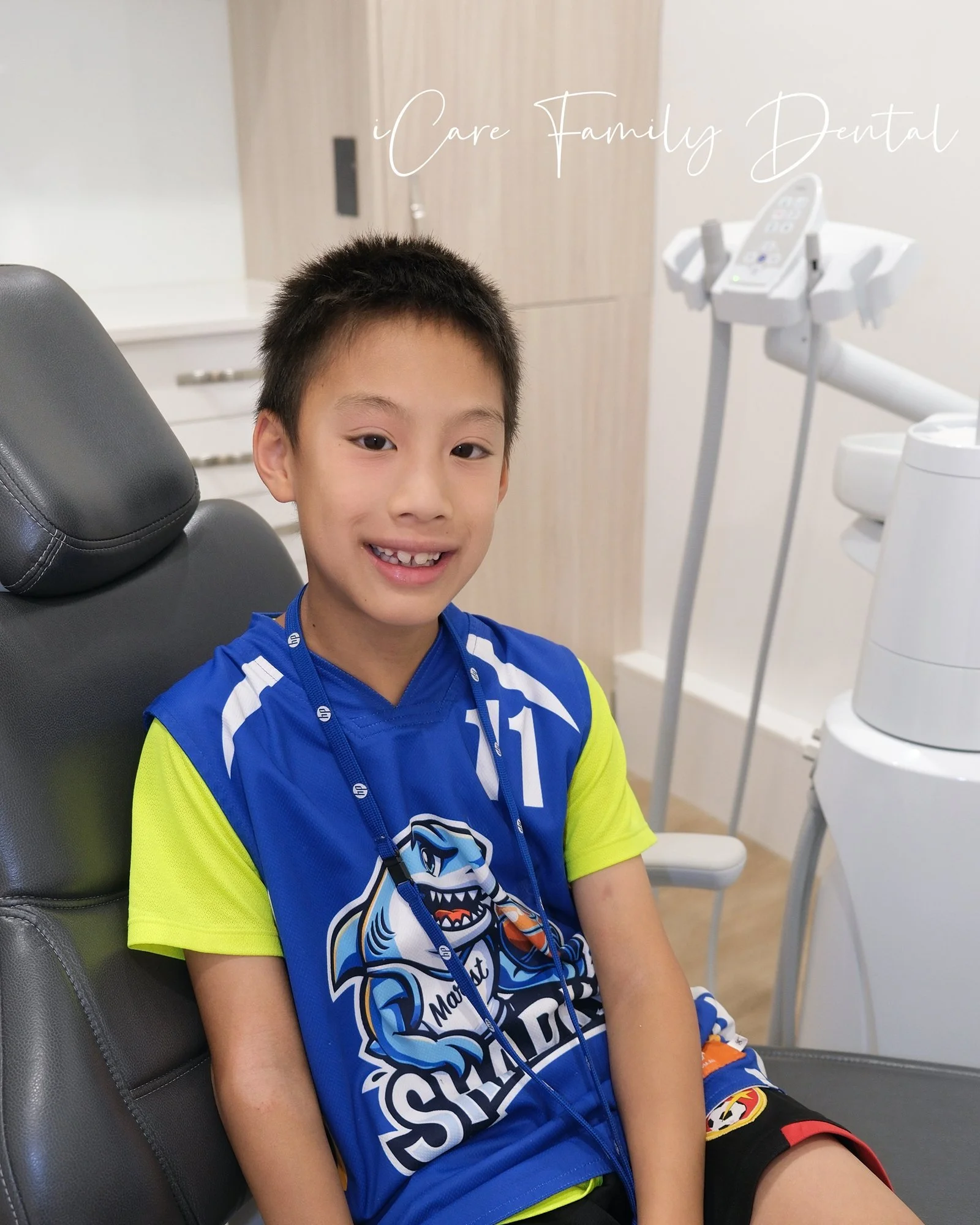
A familiar local setting for your child’s visit
These photographs show children visiting an iCare treatment room. They are visit-experience images, not testimonials, cases or treatment results.

A clear local starting point
Visit iCare Family Dental
iCare Family Dental provides general dental care for children from infancy through age 17 in Chatswood. Consultations are available in English, Mandarin and Cantonese, and the practice has 200+ five-star Google reviews.
- Address
- Shop 3, 379 Victoria Avenue, Chatswood NSW 2067
- Entrance
- On the Archer Street side
- Parking
- Two hours free parking at Chatswood Chase
- Train
- About a seven-minute walk from Chatswood Station
- Hours
- Monday–Saturday, 10:00 am–5:30 pm; Sunday closed
- Phone
- (02) 8068 6828
How to book your child’s visit
Use the online booking link and select the general Consultation appointment type. The booking form does not include a box for the reason for the visit, so you can explain what brings your child in when you arrive.
If your child has pain, swelling or an injury, if you are unsure which appointment to choose, or if you want to discuss significant anxiety, sensory or communication needs before attending, call the practice on (02) 8068 6828 instead.
A clearer next step for your child
Start with the concern you have now. The dentist can assess it, explain what is and is not needed, and help you understand the next step.